
After a P.A.D. Diagnosis: How to Keep Your Care Team and Foot Health on Track
One appointment focuses on your circulation. Another doctor asks about your blood pressure or cholesterol. Then your podiatrist notices a small area of irritation on your foot that needs attention.

Before long, you’re seeing different healthcare professionals, receiving different recommendations, and trying to remember what everyone told you.
If this sounds familiar, you’re not alone.
Living with Peripheral Artery Disease (P.A.D.) sometimes means managing several aspects of your health at once. The challenge isn’t simply getting the right treatment. It’s making sure that the different parts of your care work together.
At Capital Foot Care, we believe patients should understand their treatment plans and feel comfortable asking questions. Your foot health is an important part of managing P.A.D., and knowing how to stay involved in your care can make the process much less overwhelming.
What Does Coordinated P.A.D. Care Actually Mean?
When you hear the phrase multidisciplinary care, it may sound complicated.
In practice, it simply means that healthcare professionals with different areas of expertise contribute to your treatment when needed.
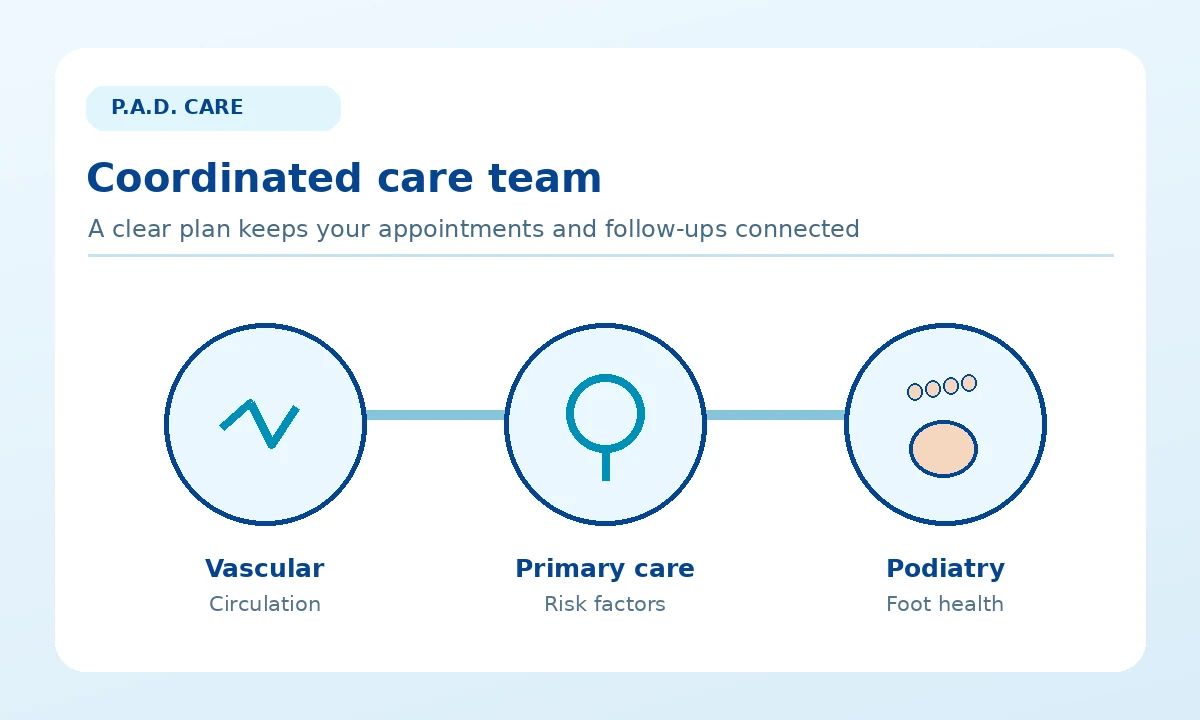
A vascular specialist may evaluate blood flow in your legs. Your primary care physician may help manage cardiovascular risk factors, while your podiatrist monitors your feet for wounds, skin changes, and other concerns.
Not everyone with P.A.D. needs every specialist.
The right combination depends on your symptoms, medical history, circulation, and whether complications have developed.
What matters most is having a treatment plan that addresses both your overall cardiovascular health and the condition of your legs and feet.
Make Sure Everyone Has the Same Information
Here’s something patients don’t always think about: one doctor may not automatically have access to the test results or treatment recommendations from another office.
That makes communication particularly important.
If you’ve recently had a circulation test, started a new medication, or undergone a vascular procedure, share that information with the other healthcare professionals involved in your care.
Consider keeping a simple record of your current medications, recent test results, appointments, and any new symptoms.
You don’t need an elaborate medical notebook. Even a short list on your phone can be helpful.
For example, if your leg discomfort has changed from occurring after a long walk to appearing after only a few steps, that’s worth mentioning.
Small details can help your healthcare team understand whether your condition is changing.
Don’t Let Your Feet Get Overlooked
P.A.D. is a cardiovascular condition, but its effects often become noticeable in the lower limbs.
Reduced circulation can make it harder for tissues to receive the oxygen and nutrients they need. This may affect wound healing and increase the importance of preventive foot care.
That’s why your feet deserve regular attention, even if your main concern is leg pain.
The American Heart Association and American College of Cardiology recommend a comprehensive foot evaluation at least annually for patients with P.A.D., with more frequent assessments when individual risk factors warrant them.
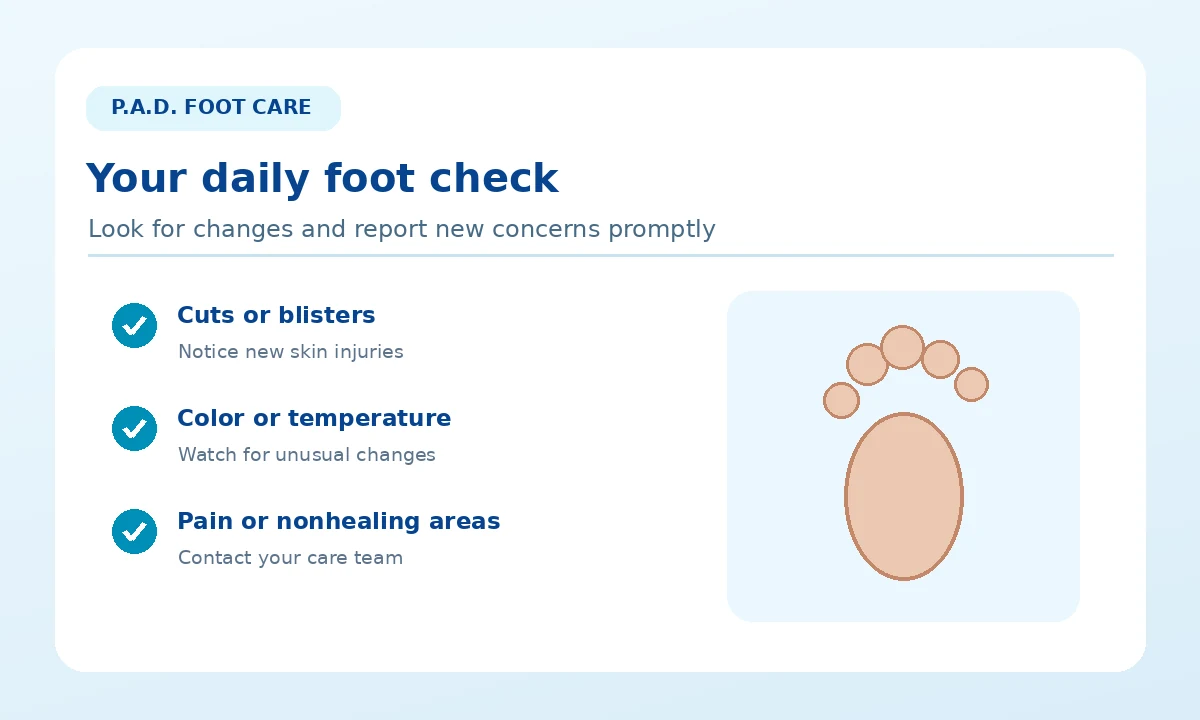
At home, inspect your feet for cuts, blisters, redness, discoloration, or wounds. Wear protective footwear and avoid attempting to cut corns, calluses, or damaged skin yourself.
If you have diabetes or neuropathy, these precautions become especially important because you may not feel an injury developing.
What Happens When Your Treatment Plan Changes?
Imagine you’ve been managing P.A.D. for several months.
Your doctor adjusts your medication, recommends a structured walking program, or refers you for additional vascular evaluation.
What happens next?
Ideally, your care plan should explain who is responsible for the next appointment, what you should monitor, and when your progress will be reassessed.
If you’re prescribed a structured exercise program, ask how to participate safely based on your symptoms and overall condition.
If you’ve undergone a procedure to improve blood flow, continue attending the recommended follow-up appointments. Improved circulation doesn’t eliminate the need for ongoing cardiovascular management or preventive foot care.
And if you have an active foot wound, your wound-care and vascular treatment plans may need to be coordinated closely.
Never assume that one successful treatment means every aspect of P.A.D. has been resolved.
The Questions Worth Asking at Your Next Appointment
You don’t have to understand every medical term to participate in your care.
Sometimes a few straightforward questions can make the biggest difference.
Ask which symptoms you should monitor at home. Find out whether your next appointment should focus on circulation, medication management, or foot care.
If you’re taking several medications, ask your prescribing clinician to explain their purpose and whether any changes have been made.
If walking is becoming more difficult, discuss whether a structured exercise program is appropriate.
And if you’re seeing more than one specialist, ask who should be contacted when a new concern develops.
The goal is to leave each appointment knowing what happens next—not wondering whether you’re supposed to arrange something yourself.
Know When Something Can’t Wait
Although P.A.D. often requires long-term management, certain changes need immediate attention.
A foot or leg that suddenly becomes severely painful, unusually cold, pale, numb, or weak may indicate an abrupt loss of circulation. This is a medical emergency and requires immediate emergency care.
New wounds, worsening discoloration, or pain in the foot while resting also require prompt medical evaluation.
If you already have P.A.D. and develop a wound that isn’t healing, don’t wait until your next routine appointment to mention it.
Recognizing these changes and acting quickly is an important part of protecting your health.
How Capital Foot Care Fits Into Your P.A.D. Care Plan
Your podiatrist can be an important member of your healthcare team, particularly when circulation problems affect the health of your feet.
At Capital Foot Care, Dr. Muhammad A. Khalid, DPM, Dr. Riasat Ali, DPM, and Dr. Herman Zarate provide patient-focused podiatric care for a variety of foot and lower-limb conditions.
Our services include Peripheral Artery Disease evaluation and management, Diabetic Foot Care, Advanced Wound Care, and Routine Foot Care.
Depending on your needs, a foot evaluation may include assessing the skin, identifying pressure areas, reviewing wounds, and examining signs that could suggest circulation or nerve-related problems.
When additional vascular or medical treatment is needed, coordinated care with appropriate healthcare professionals can help address concerns beyond the feet.
Your P.A.D. Care Should Make Sense to You
Managing P.A.D. isn’t always about doing more. Sometimes it’s about making sure the care you’re already receiving is connected, understandable, and appropriate for your needs.
At Capital Foot Care, we’re here to help patients take an active role in protecting their foot health.
We welcome patients at our locations in Riverdale, Takoma Park, and Germantown, Maryland, and Washington, DC.
You deserve to understand what’s happening with your health—and to know what steps come next.
Frequently Asked Questions About Coordinated P.A.D. Care
Do I need several doctors to manage P.A.D.?
Not necessarily. Your care team depends on your symptoms and medical needs. Some patients can manage their condition with a primary care clinician and appropriate follow-up, while others benefit from vascular specialists, podiatrists, or additional professionals.
Why should I see a podiatrist if I already have a vascular specialist?
Vascular specialists focus on circulation, while podiatrists help monitor and manage conditions affecting the feet. Both may contribute to your care, particularly when wounds, diabetes, or changes in foot sensation are present.
How often should my feet be examined if I have P.A.D.?
A comprehensive foot evaluation is generally recommended at least once a year. Patients with wounds, diabetes, neuropathy, or other risk factors may need more frequent visits based on their clinician’s recommendations.
What should I bring to a P.A.D. follow-up appointment?
Bring an updated medication list, relevant test results, information about recent procedures, and notes about changes in leg pain, walking ability, or foot health. These details can help your provider evaluate your progress.